Weekly review template PDF, US Letter
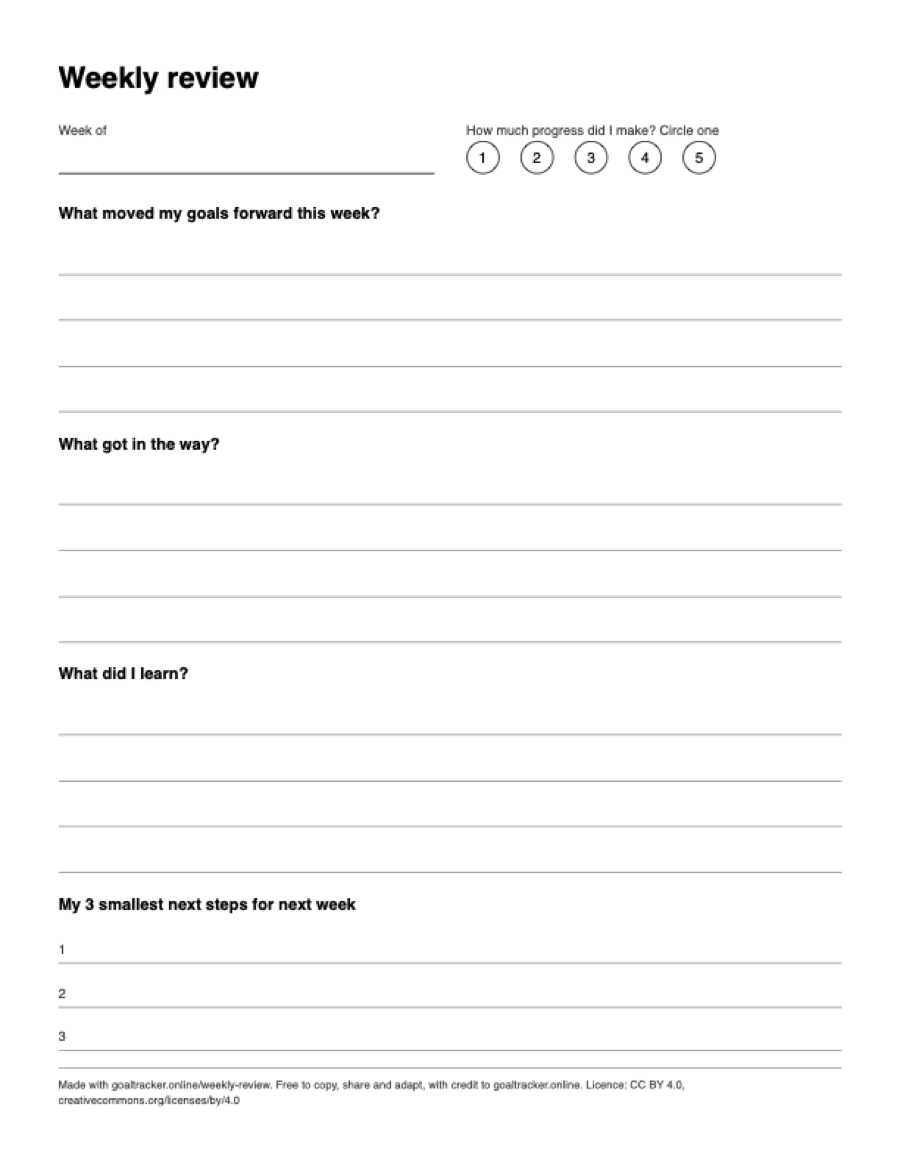
A blank one-page weekly review to fill in by hand: a 1 to 5 progress score, three questions about the week, and the 3 smallest steps for next week. Nothing to sign up for.
One page, 8.5 × 11 in (215.9 × 279.4 mm). Need the other size? Weekly review PDF, A4.
What is on the sheet
- A line for “Week of”.
- The question “How much progress did I make?” with the numbers 1 to 5 in circles, to circle one.
- Three questions, each with 4 ruled lines: “What moved my goals forward this week?”, “What got in the way?” and “What did I learn?”.
- “My 3 smallest next steps for next week”, with three numbered lines.
- A small credit line at the bottom. There is no logo or colour on the sheet.
On Letter the lines run the full 7.4 in width and sit a little under half an inch apart: room for a full sentence per line.
How to print it on US Letter paper
US Letter is 8.5 × 11 in (215.9 × 279.4 mm), the standard paper size in the United States and Canada, and common in Mexico and the Philippines. The file is one portrait page with 14 mm margins, which leaves a printable area 7.4 in wide.
- Open the PDF and choose Print.
- Set the paper size to Letter and the scale to 100% (some print dialogs call it “Actual size”). “Fit to page” also works, but shrinks the sheet slightly.
- Print in portrait. The sheet is black and white, so a mono printer or the grayscale setting is enough.
For a half-letter planner (5.5 × 8.5 in), print it at 64%. Half letter is a little taller in proportion than Letter, so the sheet fits the width and leaves a blank strip at the bottom.
If your printer holds A4 paper, use the A4 file instead. A Letter page printed on A4 paper is either scaled down or loses a strip at the side, because A4 is 6 mm narrower. Get the A4 version.
How to fill it in
- Pick a fixed time, for example Sunday evening or Friday after work, and write the date of the week’s first day on the “Week of” line.
- Circle a score from 1 to 5 before you write anything else. It is a gut reading of the week; the questions below explain it.
- Under “What moved my goals forward”, list what you finished, not what you were busy with. Two honest lines are better than four padded ones.
- Under “What got in the way”, name the thing itself: “no free evening until Thursday” is more useful than “no time”.
- Under “What did I learn”, write one thing you would do differently, or one thing that worked and is worth repeating.
- Write 3 next steps, each small enough to finish in one sitting. If a step needs more than an hour or two, write its first part instead.
Paper or screen
The online weekly review template asks the same questions, prints or downloads as Markdown when it is filled in, and can add a weekly reminder to your calendar. Open the online weekly review template. It runs in your browser and nothing you type is sent anywhere.
To check steps off day by day and keep a streak, use the free goal tracker: no account, and your goals stay on your device.
Questions
How long does a weekly review take?
It is built to take about ten minutes: one score, three questions and three steps. If it takes much longer, write less per question rather than skipping a week.
What do I do with the old sheets?
Keep them in one folder or clip. Once a month, lay the last four side by side and read the “What got in the way” boxes together: a blocker that shows up three weeks running is the one to fix.
Can I type into the PDF?
No. The file is a flat page for printing and writing on, not a fillable form. To type instead, use the online weekly review template, which can be printed or downloaded when it is filled in.
Reuse
Free to copy, share and adapt, including in a classroom, a workshop or a newsletter, as long as you credit goaltracker.online. The licence is CC BY 4.0, and the credit line is already printed at the foot of the sheet.
More blank PDFs on US Letter
- Mandala chart PDF, US Letter
- 30-day habit tracker PDF, US Letter
- Goal tracker PDF, US Letter
- Eisenhower matrix PDF, US Letter
- Daily planner PDF, US Letter
Related: a guide to the weekly review for goals, six ways to measure goal progress, all free tools and templates.